By Tom Dvorak
4 days in Amsterdam is always the best opportunity to take stock of the industry. This year was no exception. AI, short-form, content discovery, trust, optimizing costs and fighting churn were some of the themes that kept coming up for us during IBC. One thing became clear, we’ve moved past the era of AI as a talking point. The conversations weren’t about whether AI belongs in the media workflow anymore, they were about where, exactly, it fits and how much responsibility comes with it.
AI and Trust – Finding the Balance
For a couple of years, AI at IBC has felt like a broad, slightly abstract promise. This year, it got concrete. Attendees weren’t asking “should we use AI?”, they were asking specifics about content discovery, content tagging, editorial oversight and where AI-driven decisions need a human check on them. AI is threading itself into specific, defined roles across the media workflow, from ingest and metadata to personalization and monetization.
As AI takes on more decision-making about what audiences see, how do we make sure people still trust what they’re being shown? Trust isn’t an abstract virtue anymore, it’s become the operating currency of the relationship between a platform and its audience. This kept coming up in various conversations. If viewers don’t trust the “why” behind a recommendation, all the AI sophistication in the world won’t build the loyalty a platform actually needs.
This is exactly where sovereign discovery came up again and again in conversations we had on the show floor. Editorial and compliance teams, especially for public broadcasters, increasingly need visibility and control over the logic behind what surfaces on their platforms, in real time. That’s not a nice-to-have for public broadcasters and national platforms, it’s core to their remit. Being able to see and adjust ranking logic, screen by screen, ensures a platform can meet its public service obligations without surrendering that responsibility entirely to a black box. Practically, that transparency also earns viewer trust, when a platform can stand behind why something was recommended, that consistency becomes the foundation loyalty is built on.
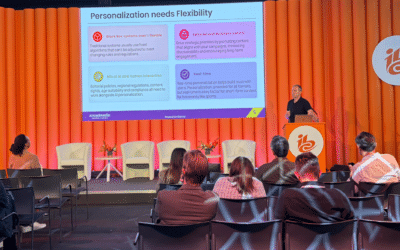
During IBC in Amsterdam, I shared insights on the Content Everywhere stage on the importance of personalization with flexibility in the age of rules and regulations. Today the media and entertainment world is full of regulations and the demand for personalization has never been higher. Users expect tailored experiences, but regulators and content owners have their own demands that need to be followed by the service provider. I highlighted the importance of requiring a solution you can fully control and customize to your needs.
Vertical Video Isn’t Just a Trend
The second theme that kept surfacing was vertical, short-form video and how it’s reshaping who platforms can reach. Younger audiences are engaging with content in fundamentally different formats than the audiences platforms were originally built around and the panels and conversations at IBC reflected an industry that’s finally taking that seriously rather than treating it as a side experiment.
There has been a shift, it was the recognition that vertical video isn’t something you can bolt onto an existing experience. It has to be woven into the whole user journey. How content is discovered, how it’s recommended, how the interface itself adapts. Platforms that treat short-form as a separate silo will struggle to build the kind of regular engagement that keeps younger viewers coming back. The ones getting it right tailor the entire experience around how these audiences actually watch.
Together with Qvest, we demoed at IBC how we can tailor the whole user sports experience across short-form, long-form, personalizing based on team and sportspersons’ preferences.
Viewers Expect Seamless Content Discovery
In the last few years, there’s been a real uptake, platforms have invested seriously in improving how people find what they want to watch. But if IBC2026 made one thing clear, it’s that user expectations are a moving target. Viewers increasingly expect discovery to feel conversational, so voice search and natural language queries aren’t a novelty anymore, they’re becoming the baseline expectation for how people want to interact with their content.
During IBC, I joined a panel to discuss the findings of the Ofcom, DTG and Goldsmiths report, which highlights how simple design is needed to increase usability for different age groups. As UIs develop, they are becoming more complex, widening the gap between Gen-Z and older generations in being able to watch content easily. With the fragmentation of apps and services, content discovery needs to be seamless and tailored so all audiences can find what they want to watch.
You can watch the session
here.
The gap between “discovery has improved” and “discovery feels effortless” is where a lot of the next wave of competitive advantage is going to be won or lost. During the show, our stand was busy with conversations about how real-time personalization is delivering the discovery experiences that viewers are demanding. Here’s where I’ll be candid, because I think the industry benefits from that honesty. Alongside all this innovation, there was a very real thread of hesitation running through IBC this year. People are keen for innovations, but budgets are tighter and against a backdrop of ongoing economic and geopolitical uncertainty, we’re seeing longer decision cycles and more caution before committing to new investment. That caution is showing up very specifically around churn. Retaining subscribers has become a front-and-center priority compared to acquisition. But the key is getting ahead of churn before it happens, rather than reacting after a subscriber has already disengaged, is where the real value is right now. And it’s changing how service providers evaluate technology partners. With less room for experimentation, the bar for any new investment is simpler and harder at the same time. New solutions have to work seamlessly within the ecosystem a provider already has. Nobody has an appetite for a rip-and-replace project right now. The winning technology is the one that integrates cleanly, proves value quickly and doesn’t ask a stretched team to take on unnecessary risk. If I had to sum up IBC2026 in one sentence, it’s that the industry has stopped asking what’s possible and started asking what’s responsible, what’s sustainable and what actually works within the constraints teams are operating under today. Trust, personalization, discovery and smart investment aren’t separate conversations anymore. Viewers want to feel understood and respected. Platforms want partners who make that easier, not harder, to deliver, without adding cost or complexity they can’t absorb right now.Budgets Are Tight and Caution is the Word of the Show
Post IBC Thoughts